Agent node
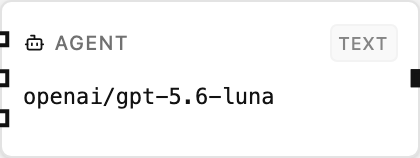
The Agent node calls a language model through the AI gateway. It is the core “brain” of most flows.
Handles
| Handle | Purpose |
|---|---|
In | Main line — the payload becomes the prompt (unless prompt overrides) |
prompt | Instruction override — replaces the payload-derived prompt |
file | Files — images and PDFs are sent as model file inputs |
Configuration
- Model — the gateway model id (e.g.
openai/gpt-5.6-luna). - Instructions — a system prompt that always applies.
- Output —
text(free-form) orjson-schema(structured).
Structured output
In json-schema mode you describe the response shape. The schema root must
be { "type": "object" } with at least one property. Example schema:
{
  "type": "object",
  "properties": {
    "label": { "type": "string" },
    "confidence": { "type": "number", "description": "0 to 1" }
  },
  "required": ["label", "confidence"]
}
Advanced settings
- Temperature — randomness (empty = provider default).
- Max tokens — response length cap.
- Seed — deterministic output.
- Input from — dot-path to a field of the incoming payload to use as the prompt instead of the whole payload.
Example — classification
Prompt node → Agent (json-schema output with label + confidence) →
Router (branches on label).
Notes
- A model without vision cannot read image inputs — the node warns when you wire an image source into it.
- PDFs require a model with document input (the
gpt-4.1family works). - Structured output and tool calling cancel each other out on some models — Sobmit uses a two-call pattern (research, then extract) when both are needed.
Related
- Prompt — feeding instructions.
- Upload File — feeding PDFs and images.