Video Generation node
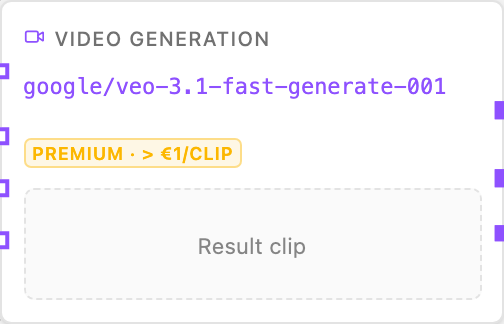
The Video Generation node produces a video clip from a text prompt using a dedicated video model.
Handles
| Handle | Purpose |
|---|---|
prompt | The text prompt describing the clip |
first | The starting frame (image) |
last | The ending frame (image) |
references | Reference images or clips (reference-to-video) |
Configuration
- Model — the video model.
- Aspect ratio — e.g.
16:9,9:16. - Resolution — e.g.
1280x720. - Duration — clip length in seconds.
- FPS — frames per second.
- Seed — deterministic output.
- Generate audio — whether to synthesize audio with the clip.
Important: model capabilities
Video models differ in what inputs they accept:
- Veo 3.0/3.1 — text + first/last frame. It does not accept arbitrary reference images.
- Kling t2v — text only. Kling i2v — a single starting image.
- MiniMax H3 — image-to-video (a single starting image), no references.
- Wan 3.0 Video — the reference-to-video model: accepts images and clips.
The node warns — and the engine fails fast with an actionable message — when you wire references into a model that cannot consume them.
Example — text + first frame
prompt: "A drone flyover of the coastline at golden hour"
first: <generated or uploaded image>
model: alibaba/wan-v3.0-video
Story continuation
The node also emits the clip’s first and last frame as images, so a second
Video node can start where the first ended (wire First frame / Last frame source handles into the next node’s first/last targets).
Notes
- Video generation is premium — a single clip can cost over €1, and the node card shows a badge to warn you.
- Generated clips are saved to the node’s artifact history.
Related
- Merge Videos — concatenate clips.
- Image Generation — producing start/end frames.