Deep Research node
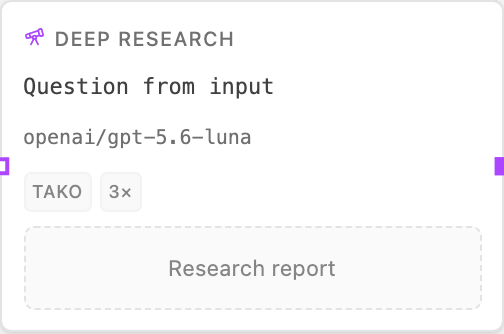
The Deep Research node runs a multi-round research loop: several search rounds run in parallel, each covering a different angle of the question, then a final synthesis pass writes a single cited markdown report.
How it works
- The query is split into complementary angles (core facts, what sources miss, verification, broader context).
- Each angle runs as an independent search round with the deep search lever.
- A synthesis call merges the findings into a report with numbered inline citations and a source list.
Configuration
- Provider — the search backend (Tako, Exa, Perplexity, Parallel).
- Model — the language model (reasoning-capable models work best).
- Query — the research question (may reference
{input.*}templates). - Max iterations — number of parallel rounds (1–8).
- Max results — results per round.
Example
Query: What are the current best practices for RAG evaluation? with maxIterations: 3. The node returns:
{
  "report": "# RAG evaluation\n\n…cited markdown…",
  "sources": [{ "url": "https://…", "title": "…", "quote": "…" }]
}
Notes
- Rounds run in parallel, so
maxIterations: 3costs roughly the time of one round, not three. - Each LLM call is billed separately and attributed to the run.
- Use Web Search for a quick single-pass answer; use Deep Research for a thorough, sourced report.
Related
- Web Search — the single-pass variant.
- Output — rendering the report.
- Use cases — one research pass feeding a summary, a table and a deck.